

It’s been a few years since I’ve last picked up a cube seriously. Between uni, work, and my life in general, I’ve had little time to practice. However, I’ve decided to change that. The goal of 2024 is a 3x3 best of sub-15. This post will contain my roadmap to achieving that goal.
Why Sub-15?#
Sub-15 is THE milestone for an intermediate cuber. It’s the point where you can start branching out from general advice, and methods. Methods like CFOP, Roux, ZZ, all become viable, because you master the basics. It’s also a good point to start learning more advanced techniques, like lookahead, and advanced F2L.
The Roadmap#
Step 1: Relearn CFOP#
CFOP (Cross, F2L, OLL, PLL) is the most used method in 3x3. There’s a reason most beginners start with it. It’s fast, efficient, and easy to learn. As a start, I will re-learn OLL and PLL algorithms, and try to get them to sub-1.5 seconds each.
PLL#
PLL (Permutation of the Last Layer) is the last step in CFOP. It involves permuting the last layer of the cube. There are 21 algorithms in total.
Below is an example of a PLL algorithm, permuting the corners of the last layer.

OLL#
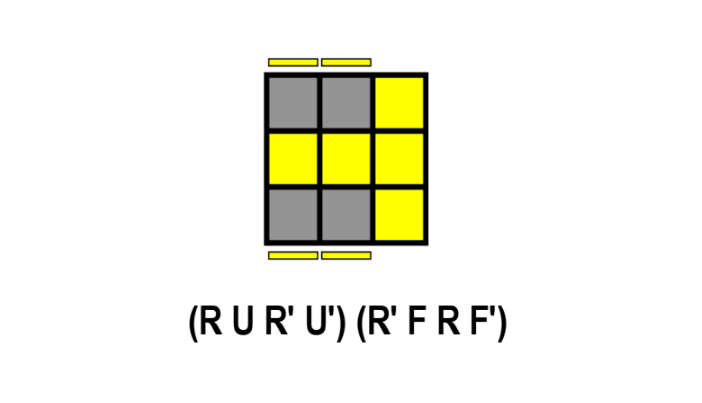
OLL (Orientation of the Last Layer) is the second last step in CFOP. It involves orienting the last layer of the cube. There are 57 algorithms in total.
Below is an example of an OLL algorithm, orienting the corners of the last layer.
Step 2: Practice F2L#
First Two Layers - arguably the most important step in CFOP. It involves solving the first two layers of the cube at the same time. It’s also the step where most of the time is spent.
There are 41 algorithms in total, but I will focus on intuitive F2L, as it’s faster and more efficient.
Intuitive F2L vs Algorithmic F2L#
Intuitive F2L means solving the first two layers without any algorithms, and using your intuition, and knowledge of how pieces move and rotate, so place them in the correct position. It is faster, and more efficient than algorithmic F2L, but requires more practice, and its magnitudes harder to learn.
Algorithmic F2L involves learning algorithms for each case, and executing them. It’s slower, but easier to learn, and requires less practice. It is similar to OLL and PLL, where you only need to recognize the case, and execute the algorithm.
Below is a picture of an algorithmic F2L case, where you need to insert the corner and edge pair into the correct slot.
This could easily be looked at in an intuitive way, by rotating the cube, and inserting the pair into the correct slot, instead of memorizing the algorithm, which is also very simple, but would take up space in your memory, and slow you down.
Step 3: Lookahead#
Lookahead is the ability to plan your next moves while executing your current ones. It’s a crucial skill to master for sub-15 solves. I will practice lookahead by doing slow solves, and focusing on tracking pieces.
Here’s a great video on lookahead by J Perm:
Step 4: Practice, Practice, Practice#
My goal is an hour of practive every day, or every other day. My main focus will be slow solves , these will help me develop lookahead, and improve my efficiency. These will mostly be untimed, but once I gain confidence in my lookahead, I will start timing myself, and picking up the pace.
Summary#
This is a rough outline of my goals for 2024. I will update this post as I progress, and achieve my goals. Wish me luck!